

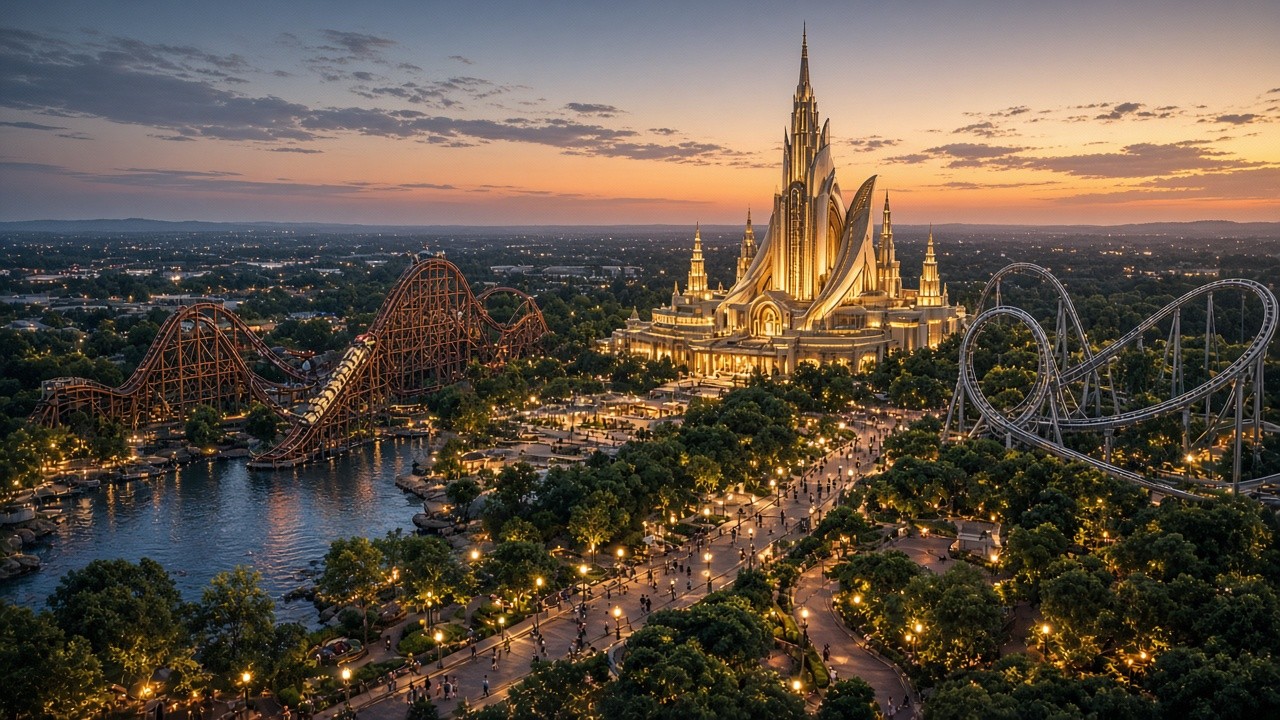
The 2025 TEA Global Experience Index — the latest edition of the study long known as the TEA/AECOM Theme Index — ranks America’s parks by attendance. Disney still leads. Epic Universe just crashed the list.
Forget the marketing. The only honest way to rank America’s biggest theme parks is to count who actually walked through the gate. The 2025 TEA Global Experience Index — the 20th edition of the annual attendance study long published as the TEA/AECOM Theme Index — landed on 27 October 2026. It is the industry’s benchmark. And the story it tells about 2025 is simple: Disney still sits on the throne, Universal just changed the map, and acreage is a brag, not a ranking.
The 2025 attendance table, from the top
The Index’s North American top 20 recorded 143.1 million visits in 2025, up 1.5 per cent from 141.0 million in 2024. One of those 20 is in Canada. The rest are the biggest parks in the United States, ranked here by the official 2025 figures.
Magic Kingdom at Walt Disney World remains number one in America and in the world, at 17.8 million visits, a dip of 0.2 per cent. Disneyland Park in Anaheim is right behind it, at 17.406 million, up 0.4 per cent. Then the Florida machine keeps rolling: EPCOT at 12.109 million, Disney’s Hollywood Studios at 10.312 million, and Disney California Adventure at 10.090 million. Universal Studios Florida follows at 9.3 million (down 2.1 per cent), Islands of Adventure at 9.2 million (down 2.6 per cent), and Disney’s Animal Kingdom at 8.782 million. Universal Studios Hollywood, hit in a year the Index links to the aftermath of the Los Angeles wildfires, fell 8.0 per cent to 8.0 million.
Below that, the regional heavyweights still pack a punch. SeaWorld Orlando drew 4.335 million, Knott’s Berry Farm 4.315 million, SeaWorld San Diego 4.015 million. Then comes the new gate: Universal Epic Universe, with 4.0 million visits in a partial first year, landing 13th in the North American table. Busch Gardens Tampa Bay follows at 3.8 million, Cedar Point at 3.497 million, and Dollywood at 3.4 million — the standout gainer, up 8.1 per cent. Canada’s Wonderland, in Vaughan, Ontario, sits 17th in the continental list at 3.232 million, which is why the next American names are Kings Island at 3.226 million, Six Flags Magic Mountain at 3.184 million, and Hersheypark at 3.050 million. That is the official US order. Unofficial guesses about who almost made the 20 do not belong on this list.
Attendance is the ranking. Acreage is the flex. Disney’s Animal Kingdom spreads over 500 acres and still sits eighth in America. The new park that just crashed the list is a lot smaller — and already very loud.
How big is “big,” in acres
Disney’s own press office has long called Animal Kingdom the company’s largest theme park, “spreading over 500 acres.” That is the official figure, and it explains the safari-scale footprint that a Magic Kingdom parade ground was never going to match. At the other end of the country, Disney’s 2024 Disneyland Resort fact sheet describes the Anaheim destination — two parks, three hotels and the Downtown Disney District — as an approximately 500-acre resort. Size, here, is a campus, not a single gate.
Epic Universe is the new comparison point. WESH, reporting just before opening, said the park and its five themed worlds span 110 acres, on a 750-acre property with room to grow. It is not the biggest plot in Florida. It did not need to be.
The gate that changed the map
Epic Universe opened on 22 May 2025, the first mega theme park built in Orlando in more than 25 years, the Index notes. The worlds are Celestial Park, SUPER NINTENDO WORLD, The Wizarding World of Harry Potter – Ministry of Magic, How to Train Your Dragon – Isle of Berk, and Dark Universe. Four million visits in a short year is a debut, not a full-season run. The Index also records the trade-off: Universal’s two established Orlando parks dipped, but the new gate helped generate a 4.3 per cent increase in combined attendance for Central Florida’s leading theme parks — ahead of the 1.8 per cent rise in tourists Visit Orlando reported for 2025. Florida’s nine parks on the list accounted for 79.6 million visits; California’s six, 47.0 million. The country still has two theme-park capitals. One of them just got a fourth door. The Index also notes that 2025 was the first full year after the Six Flags and Cedar Fair merger, a stretch marked by weather and portfolio pruning at the regional parks — Cedar Point and Kings Island both declined — while Dollywood, under family-owned Herschend, was the rare big gainer. “Biggest” is no longer only a Florida story, but Florida still writes most of the top of the chart.
This is the other American spectacle economy, the one that does not need a nightclub or a starting grid. It competes for the same weekends as the Strip we mapped in the craze for Las Vegas, and for the same Gen Z attention we tracked in how young women are chasing money and a fast life. The calendar is already a battleground; see our 2026–27 events guide. Even the housing market tells you where the destination money sits, from LA’s costliest estates to the biggest homes in the country.
Live music is in the same fight for leisure time. Celebrityfees has the highest-grossing concert tours of all time; The Global Concert has the November 2026 tour calendar; Global Celebrity Meter has already flagged how a single city can swallow a year of dates, with Pink’s 2027 Sphere residency. The parks still win the family ticket. The Index just showed that a new gate, opened in May, can walk 4 million people in before it has even had a full calendar year. That is what “biggest” looks like in America now: not the widest plot, but the one the turnstiles cannot ignore.