

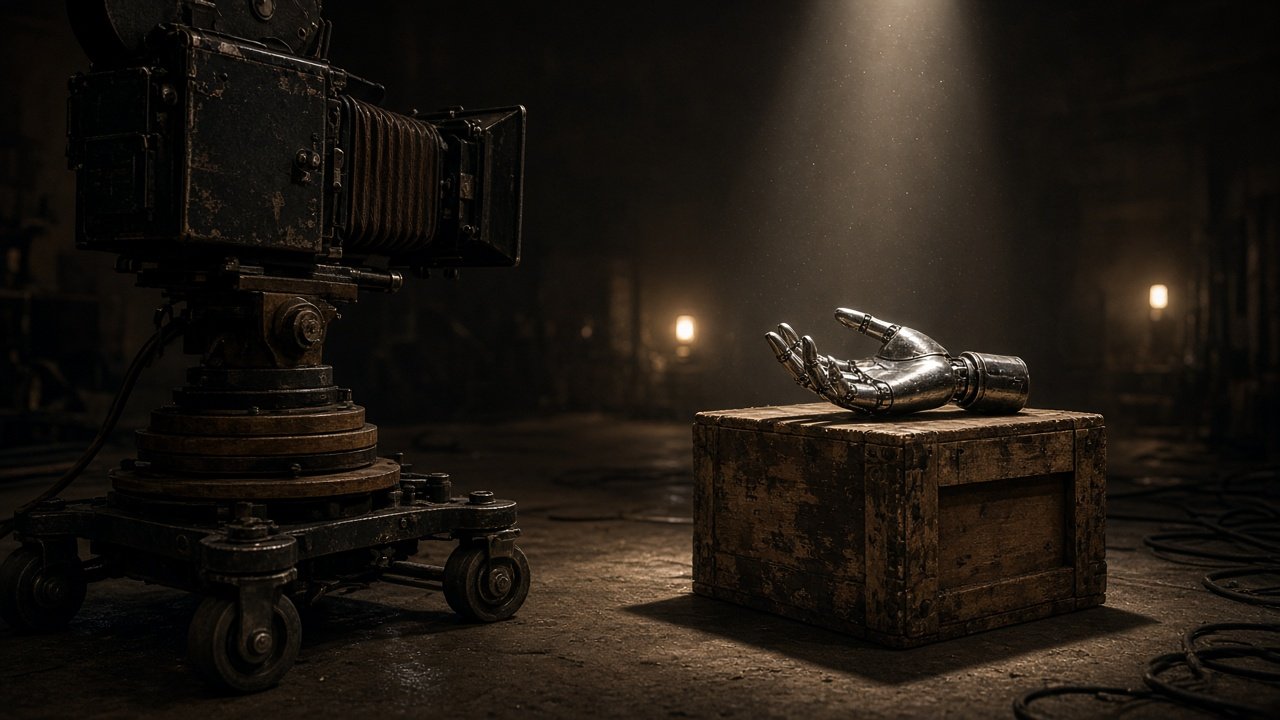
AI in Hollywood is already in the shot, the contract, the lawsuit and the union briefing. The machine did not wait for a verdict. A building collapsed on a Netflix screen with generative effects. A union president told Washington it had performed miserably. Studios sued an image model, then shopped licenses. The live question is not whether the tools work. It is who gets paid, who consents, and who gets replaced when they do.
The Body
The 2023 strikes wrote the first floor. SAG-AFTRA’s TV and theatrical agreement, from 9 November 2023 through 30 June 2026, required clear and conspicuous consent for digital replicas, advance notice before an employment-based scan, and bargaining over synthetics in human roles. The WGA’s 2023 agreement said AI is not a “writer.” A company must disclose generative drafts, cannot pay only a rewrite fee on an unpublished machine script, and cannot force a writer to use a chatbot. WGA members ratified a new MBA on 24 April 2026, running through 1 May 2030, keeping those AI rules and adding written notice if a company licenses covered scripts or produced projects to train a public commercial system. SAG-AFTRA members approved a four-year TV and theatrical agreement in June 2026, running through 30 June 2030. The Wrap reported producers must continue to “overwhelmingly” use union performers, and may put a synthetic in a union role only if it brings “significant additional value,” with notice, bargaining and arbitration. In July 2025, members also approved a new Interactive Media video game agreement with consent and disclosure rules for digital replicas, Reuters reported, plus the right to suspend consent for new generated material during a strike.
Tilly Norwood, a photoreal character created by Eline van der Velden and Particle 6, became the public test case. After a 2025 debut and talk of agency interest, SAG-AFTRA opposed “the replacement of human performers by synthetics.” In 2026, Particle 6 said it was in production on Misaligned, with Norwood in the lead. Van der Velden has said the character was not based on any specific person’s likeness. The union has alleged she was trained on performers’ work without permission. The creator disputes that claim.
On 11 June 2025, Disney and Universal sued Midjourney in the Central District of California, alleging the service trained on their works and generated unauthorized images of studio characters. Warner Bros later joined the docket. The case remains in discovery, with no merits ruling. Lionsgate partnered with Runway in September 2024 for previz, storyboarding and post. Variety reported that on 11 June 2026 the studio took an undisclosed non-cash equity stake and planned an AI-generated short-form series from its catalog. On 11 December 2025, Disney and OpenAI announced a planned three-year Sora license and $1 billion equity investment, subject to definitive agreements and excluding talent likenesses and voices. After OpenAI discontinued Sora in March 2026, the BBC reported the partnership was wound down, and Reuters reported that no money had changed hands. The NO FAKES Act of 2026 (S.4591), introduced by Senator Christopher Coons on 20 May 2026 and reported by Senate Judiciary on 24 June 2026, would create a federal right to authorize digital replicas of a person’s voice or visual likeness. It has not had a floor vote. Senator Ted Cruz blocked a unanimous-consent attempt on 30 September 2026, Forbes reported. It is not law.
Cause of Danger: Why AI in Hollywood Hits Jobs and Likeness
A CVL Economics study commissioned by the Animation Guild and the Concept Art Association projected that about 21.4 percent of U.S. film, television and animation jobs, or roughly 118,500 positions, were likely to be consolidated, replaced or eliminated by generative tools by 2026, with visual effects and post at the center. Union contracts can police a covered set. They cannot write a federal statute. In a 15 November 2026 Los Angeles Times interview, SAG-AFTRA president Sean Astin said he could say “without any hesitation that the federal government has performed miserably so far in terms of addressing the threats that artificial intelligence poses.” Hollywood Movietimes covered that briefing, including his June line to Congress: “We don’t want to stop progress, we need to civilize it.” He also said of the latest contract, “We got what we did. We slowed it down.” After a January meeting, he told van der Velden that open models were “available to everybody the way stolen jewels are available to everybody.” She disputed that claim in an email to the Times. That is why the 2026 Celebrity Booking Fees benchmark still matters, and why Global Celebrity Brand Valuation is a live argument about what a face is worth.
Signs of Life
The boon is real when the shot lands cheaper. In July 2025, Netflix co-CEO Ted Sarandos told the BBC that generative effects produced a building-collapse sequence in The Eternaut about 10 times faster than traditional tools, and that the cost “wouldn’t have been feasible for a show in that budget.” He said the tools also let smaller-budget productions use advanced visual effects. The 2024 film Here used digital de-aging on Tom Hanks and Robin Wright. Lionsgate vice chairman Michael Burns said AI will save the company “tens and tens of millions of dollars a year” in production costs, an executive claim, not an audited figure. The money funding those bets is visible on Billionaire Meter.
Danger Versus Boon, On the Record
The sourced ledger on AI in Hollywood:
| Pressure point | Danger, sourced | Boon, sourced |
|---|---|---|
| Jobs | 2024 CVL/Animation Guild projection: about 118,500 U.S. film, TV and animation jobs at risk by 2026. | Netflix told the BBC in July 2025 that an Eternaut effects shot finished about 10 times faster and was feasible on that budget. |
| Likeness | The NO FAKES Act is not law. Astin told the Los Angeles Times the federal government has “performed miserably” on AI threats. | 2023 and 2026 SAG-AFTRA contracts require consent, notice and bargaining, plus a 2026 “significant additional value” test for synthetics. |
| Catalogs | Disney, Universal and Warner Bros allege Midjourney copied their characters. The case is pending, with no merits ruling. | Lionsgate expanded its Runway partnership in June 2026. A Disney-OpenAI Sora license announced in December 2025 was later wound down. |
| Writing | The 2023 WGA strike included fears over machine drafts and training on writers’ work. | The 2023 and 2026 WGA agreements say AI is not a writer and require notice for training licenses. |
The Verdict
The autopsy cut on AI in Hollywood is a split body. The job risk in effects and animation was quantified two years ago and has not been disproved. The likeness fight is live, and Congress has not closed it. Contracts put a leash on union sets. They cannot civilize a federal vacuum. Treat the tools as infrastructure, not as unpaid cast. Pay the human. Disclose the machine. The boon is real when consent and money travel with the replica. The danger is real when they do not. If you are building at that intersection of capital, rights and models, AI Polymath Bidding is open ahead of the 24 November 2026 window.
FAQ
Did SAG-AFTRA and the WGA lock in new AI rules in 2026?
Yes, on covered work. WGA members ratified a 2026 MBA on 24 April 2026, with 90.38 percent voting yes, that keeps the 2023 rule that AI is not a writer and adds written notice if a company licenses covered material to train a public commercial system. SAG-AFTRA members approved a four-year TV and theatrical deal in June 2026 that keeps consent and bargaining rules and, according to The Wrap, adds a “significant additional value” test for synthetics in human roles.
Is the NO FAKES Act law?
No. Senate bill 4591 was introduced on 20 May 2026 and reported to the Senate calendar on 24 June 2026. It has not had a floor vote in either chamber. On 30 September 2026, Senator Ted Cruz blocked a unanimous-consent attempt, Forbes reported.
What is the Tilly Norwood dispute?
Tilly Norwood is a photoreal character created by Eline van der Velden and Particle 6. SAG-AFTRA opposed replacing human performers with synthetics and has alleged the model was trained on performers’ work without permission. Van der Velden says the character is not based on any specific person’s likeness and disputes the stolen-material claim.
Did Disney close a Sora deal with OpenAI?
The companies announced a planned three-year license and a $1 billion Disney investment on 11 December 2025, subject to definitive agreements, and said talent likenesses and voices were excluded. After OpenAI discontinued Sora in March 2026, the BBC reported the partnership was wound down. Reuters reported that no money had changed hands before the deal was cancelled.
How many Hollywood jobs did the Animation Guild study put at risk?
The January 2024 CVL Economics study commissioned by the Animation Guild and the Concept Art Association projected that about 21.4 percent of U.S. film, television and animation jobs, or roughly 118,500 positions, were likely to be consolidated, replaced or eliminated by generative tools by 2026. That is a forecast, not a completed headcount.